handMADE Montana opens in Polson
By Kristi NiemeyerTwo weeks before she opens the doors of handMADE Montana Retail and Production House to the public, Carol Lynn Lapotka is relaxed and gregarious, even though her to-do list seems insurmountable. A crew of carpenters is in the attic, repairing broken trusses in her 110-year-old building on Polson’s Main Street. A new employee is painting the inside of drawers and organizing inventory.
At the same time that Lapotka puts finishing touches on the shop/production space, she’s organizing the upcoming Summer MADE Fair, June 23 at Caras Park in Missoula. And buying a house.
“I work fairly well in intensity,” she says.
More talent than we can contain
For Lapotka, her new 2,000-square-foot space is the logical next step in a business that’s been bustling almost since its inception. She graduated from Edgewood College in Madison, WI, with a degree in fine arts, graphic design and environmental studies. Those passions meshed in REcreate Designs as she began “foraging” for fabric in thrift stores and at rummage sales, and crafting unique clothing from her finds.
She worked in her basement until she and her husband moved to Missoula in 2007 so he could attend law school. Then her business occupied the second bedroom of their rental until she found a studio space at Zootown Arts Community Center.
When her husband took a job with the Lake County Attorney’s office and they moved to St. Ignatius in 2010, she worked in a 600-square-foot studio at the end of their driveway. At the same time, the MADE fairs were expanding.
Back in Wisconsin, Lapotka had retail experience, which included helping to organize an event that attracted 20,000 people over three days, and participating in an array of “indie craft fairs.”
“I was aware of what it took – the process of gathering people and organizing things,” she says.
When she moved to Montana, she found a dearth of holiday fairs. “I’m a starter, so I made one,” she recalls.
Eventually the show landed at the Adams Center. It was hard, at first, to envision a market of handcrafted wares occupying a multi-level gymnasium. But she saw the potential, and 12 years later the two-day fair fills all three levels with vendors and shoppers. And still, she says, “we have more talent than we can contain.”
She added a summer show at Caras Park 10 years ago, and in 2017 expanded to Helena with a holiday show at the fairgrounds. Last year, she added two more: the MADE fair Marketplace during the Western Montana Fair, and a fall fair at the Brick Breeden Fieldhouse in Bozeman.
Organizing the state’s largest art and handcrafted markets seems to come as naturally to Lapotka as stitching together a whimsical skirt. “Most artists aren’t very good at floor plans,” she observes. “My brain can switch from being creative to being more structural.”
She describes organizing the fairs as “a one-woman show with really strong sidekicks.” In particular, she mentions Missoula artist Courtney Blazon, who helps with marketing, communications and reaching out to sponsors.
Still, as Lapotka points out, “A show can only happen if you have artists who want to sell stuff and people who want to buy.”
Both converge in the handMADE markets. “We have a reputation for being lucrative for the artists, well organized and very well attended.”
Last year, when the handMADE fair expanded to Bozeman, Lapotka explored a variety of venues before settling on Montana State University’s fieldhouse. “It was either go bigger or go home,” she says.
She invited 100 artists to sell their wares, and her own business had its best two sales days ever. Already, this fall’s show is attracting lots of applications from new artists.
Making simple, deliberate choices
A panel of artists and a few consumers help jury applicants for the five handMADE fairs using Submittable, an online service headquartered in Missoula, which allows jurors to look at applicants individually and share their notes. She tells jurors, “If you know someone you think should be in the show, but their pictures don’t measure up, let me know.”
“Some people’s pictures, and how they present themselves are not their strong suite,” she adds, which brings Lapotka to the other arm of her business: providing resources and education for artists and makers.
Her shop in Polson furthers that goal by having the space to offer workshops and an in-house photography studio to help artists take the kind of professional photos that will help them get into more shows and galleries.
“There are so many talented people I’ve seen out there who just need a little help,” she says.
She also plans to bring in accountants, and people with social media and marketing expertise to offer classes.
“Simple, deliberate choices can make the difference,” she says. “There’s a lot of psychology involved in how people shop, how they perceive things.”
The 400-plus artists who participate in the MADE fairs are all ages and work in a wide range of media. The common thread is their ability to offer a modern twist to time-honored crafts, from sewing, woodworking and soap-making, to jewelry, printmaking, photography and ceramics.
“So many of the artists I work with have gone from doing it as a little side hustle to really doing it full time,” she says. “That’s pretty gratifying.”
She often asks artists what it would take to turn their art into their career. “The answer is always, ‘a steady paycheck.’”
Over the years, about 25% of the artists she works with transformed their craft into a full-time business. “Some have even hired their husbands,” says Lapotka.
Building community from within
As for the local reaction to her new business, Lapotka describes herself as “curious beyond containment.”
She and her husband chose to move north to Polson instead of south to Missoula for several reasons. One is employment – her husband enjoys his job as chief deputy county attorney – and Polson has a good school district for their two kids, ages 5 and 9. Plus, commercial space and housing were more affordable.
The business community has welcomed her venture with interest and enthusiasm. She received a grant from the Polson Redevelopment Agency to help remodel her building, as well as a USDA grant to help pay for insulation and energy-efficient windows. Lake County Community Development was instrumental in helping her refine her business model and apply for financing.
Lapotka hopes HandMADE Montana and REcreate Designs contribute to the revitalization of downtown Polson, a business community that thrives during the summer months, but struggles the rest of the year.
“I’m not building this shop for people who travel through in the summer,” she says. “I’m building it for the people who live here day to day.”
She points out that several new businesses “are already doing great things,” and looks forward to adding her own spirit and experience to the mix. “I see a lot of potential here,” she says. “A slight shift has to happen, but I don’t think it’s gonna take much.”
Brodie Moll, a city commissioner and member of the Polson Redevelopment Agency, calls Lapotka a welcome addition to the downtown. “She’s hardworking and creative. She has real positive energy and wants to build the community from within … She’s not necessarily looking for tourists to save us.”
Connecting to the creators
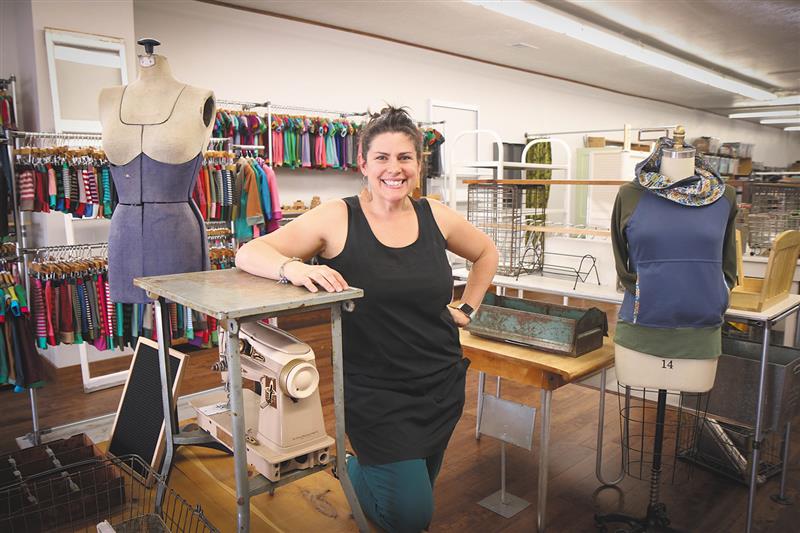
The Polson store and production house is clearly a labor of love and ingenuity. Her display cases are doors, tipped on their sides, fronting kitchen cabinets, with windows as shelves. Wide fir planks that once held shoe inventory, shelves from the old Kalispell library, a nail bin from a hardware store, an ironing board, metal milk crates, a vintage toolbox – all are put to new use, reinforcing her “recycled aesthetic.”
Big bags stuffed with shirts, skirts, and suit coats wait to begin life again in one of Lapotka’s creations.
“I love finding treasures,” she says.
As though this isn’t enough – opening a new store and production studio, and organizing five MADE fairs a year – Lapotka also hopes to find time to launch Grove Outdoors, her new line of active wear for adults and kids. Instead of recycled material, Lapotka will create her outdoor adventure wear from “dead stock,” or the fashion industry’s cast-offs – primarily leftover wool and Polartec fleece.
Expanding production “is my January project,” she says.
Her shop, once a popular shoe store, is an expansive room, with retail in the front and production tables in the back where she and a small cadre of seamstresses will make her clothing.
The potential distraction of making art in public doesn’t worry her much. Lapotka describes herself as “super gabby – I thrive off other people.”
She hopes when customers begin to walk in the front door July 1, “you’ll see something you love, something that makes you happy.”
And that something is sure to have a story behind it, a connection to its maker. “I consider that creative. I consider that art.”
(Photos): Carol Lynn Lapotka in her new handMADE Montana Retail and Production house, opening July 1 on Polson’s Main Street.
A little whimsy and a lot of work are about to begin at handMADE Montana’s new headquarters, located in a former shoe store.
Tags: MAC News