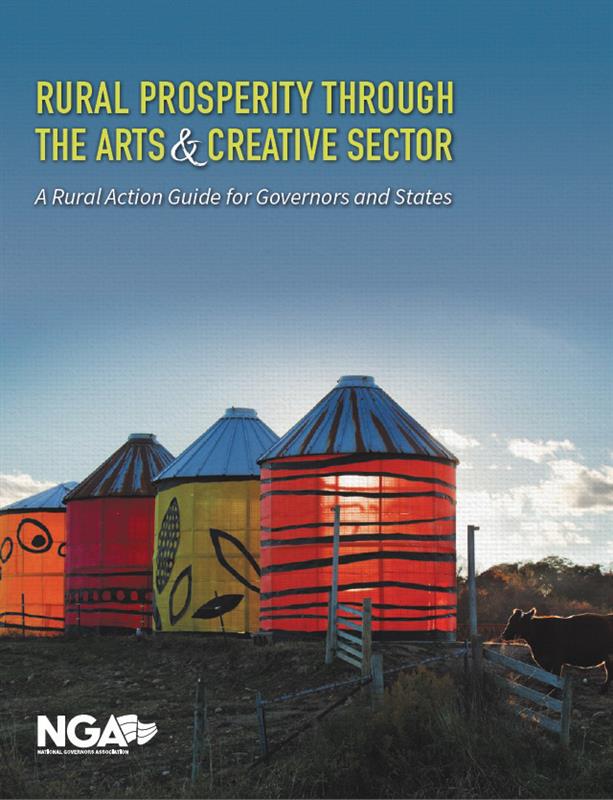
Rural Prosperity Through the Arts and Creative Sector
New guide shows how art-based economic development can help communities thrive
Struggling rural communities have found new life through smart public policies that boost the creative sector, the National Governors Association said in a report and action guide that is the product of more than a year of research across a wide swath of the country.
Rural Prosperity through the Arts and Creative Sector: A Rural Action Guide for Governors and States synthesizes a growing body of research showing how arts-based economic development – already responsible for more than 600,000 jobs in rural states – can help communities to thrive. The guide grew out of a collaborative initiative between the NGA Center for Best Practices, the National Endowment for the Arts and the National Assembly of State Arts Agencies.
The NGA undertook this project to help states address the urgent challenges facing rural communities, many of which are struggling with high unemployment rates, manufacturing declines and outmigration.
“Governors need fresh, results-oriented approaches that boost economic opportunities, create jobs, retain young people and preserve a great quality of life in our small towns and undeveloped areas,” said Scott D. Pattison, NGA CEO and executive director. “Our analysis indicates that leadership from governors and smart public policies can help the creative sector realize its potential as a catalyst of growth and pride in rural communities.”
According to the guide, when rural regions lose their traditional industries, they can capitalize on their creative assets to reimagine – and realize – a new future. Drawing on quantitative data, an extensive scan of field practices and insights from a national panel of rural development experts, the guide offers a five-point policy framework and 27 policy action steps, illustrated by 100 examples of how arts-based strategies have worked in diverse geographic settings.
“From Appalachian coal communities to our agricultural heartland to the mountain west, the examples in this action guide reveal how the arts and culture are central to rural vitality,” said Mary Anne Carter, acting chairman of the National Endowment for the Arts. “Creative placemaking opens economic doors for rural communities.”
The most recent data produced by the Bureau of Economic Analysis and the Arts Endowment show that arts and cultural industries contributed $67.5 billion and employed more than 628,000 workers in the country’s most rural states.
The NGA action guide points to the arts as a key ingredient in comprehensive rural development efforts, noting that the creative sector complements other industries and can boost the efficacy of state economic development policies, partnerships and plans.
“Including the arts in rural development efforts enriches the policies states can bring to bear in this crucial policy domain,” said Pam Breaux, president and CEO of the National Assembly of State Arts Agencies. “The resulting strategies have a unique local resonance. Rural residents love their communities and hold deep attachments to the places they call home. The arts and culture mobilize that pride and harness the optimism of rural America.”
Rural Prosperity through the Arts and Creative Sector was produced by the NGA through a cooperative agreement with the National Endowment for the Arts in collaboration with the National Assembly of State Arts Agencies (NASAA). Related resources can be found on the NGA website, nga.org, research from the National Endowment for the Arts and NASAA’s rural prosperity web page. The partner organizations are using the hashtag #ruralarts on social media.
The Montana story
The report highlights two innovative Montana Arts Council programs: Montana Teacher Leaders in the Arts and the Montana Artrepreneur Program.
In a section about applying the arts to rural health care, the report talks about MTLA: To help address the Native American teen suicide rate in Montana, the Montana State Office of Public Instruction and the Montana Arts Council teamed up with Salish Kootenai College on the Flathead Indian Reservation to create a statewide professional development program that is forming a powerful cohort of kindergarten through grade 12 (K-12) teacher-leaders for Montana classrooms. These teacher-leaders then support other teachers around the state through a close-knit social support network that is positively addressing mental health among the state’s teen population. An NEA ArtWorks grant called “Montana Teacher Leaders in the Arts” supports this effort.
A section devoted to “Enhancing art-based entrepreneurial ecosystems by supporting artist entrepreneurs” discusses MAP, which “expands entrepreneurial opportunities for rural visual artists by providing personal coaching and other business and marketing training over 10 months. Artists who received MAP certification between 2009 and 2014 experienced, on average, a 650 percent net sales increase and an 87 percent out-of-state sales increase.”
Tags: MAC News