Bach Roads of Montana
Baroque Music Montana Founder, Carrie Krause, had a big birthday this year. “My partner, Paul, wanted to take me on a trip, and I said I think I’d like to play these amazing pieces by Bach, and I want to include others in this journey.”
These pieces by Bach, a solo collection of works for violinists, take three hours to play. The stamina required “is hugely difficult but our basic text,” Krause said. “Music is such a multifaceted challenge in that there is a physical element to it. You have to be strong and efficient with your body. The consideration of history and all that one can gather about who the composer was and the place they lived in and what their motivations were. And that when we hear classical music it’s a chance to learn something about another place and a past group of people. It’s about what happens through the violin.”
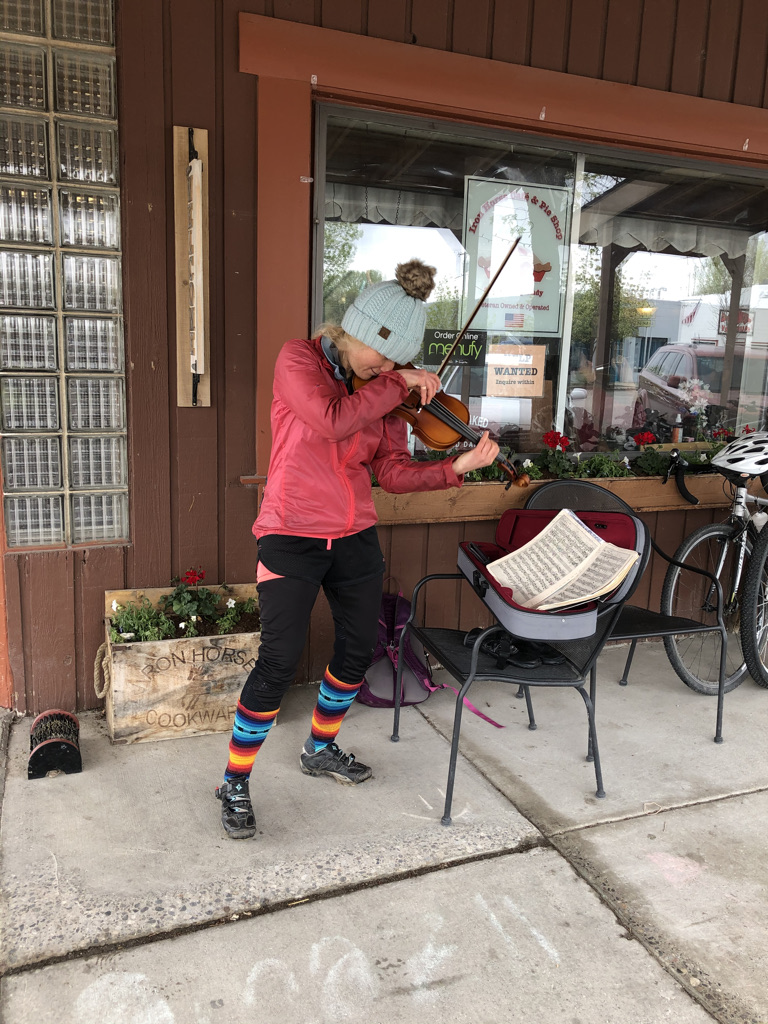
Undeterred by the challenges this posed, she presented her idea to the board of Baroque Music Montana, who embraced it and gave their wholehearted support. “We kicked it off with Bach on Main and Bach at Trails with 40 musicians playing across the valley. It was amazing to see the pictures and the crowds gathered. We started out with a parade of my younger students playing Bach from memory with their siblings racing alongside us on bikes. As part of Biking for Bach, we connected the six towns of Gallatin Valley with these six pieces through a community bike ride. I also played lighter works at coffee shops and parks along the way.”
Sometime later (this was actually over a year prior), she went on a bike ride along the Ruby River when the idea for Bach Roads of Montana struck. “I happened upon Laurin and the church there, and it made me wonder how many beautiful, tiny churches there are that we could showcase with a performance. I wondered how it sounded inside.”
She had a recording session coming and wanted a unique setting. “Any church in Bozeman, it’s too noisy because of traffic.” So, she and a recording engineering team ended up at eight churches—Basin, Townsend, Lennep, Laurin, Virginia City, Jeffers, Emigrant and Manhattan. Krause worked with local lay people at each church who provided introductions and local church history at each performance. Krause said, “We were the first concert at one of these churches and these are churches that are 100 years old!”
A Juilliard School graduate, Krause specializes in historical performance and says she uses different instruments to get closer to the music from three centuries ago. For Bach Roads of Montana, she played her recently acquired violin that was built in 1740 by Andreas Ferdinand Mayr, known as the maker of Mozart’s childhood violin. “It’s set up with gut strings, from sheep gut that’s sourced from a shop in NY that gets them from Italy.” Violin hardware has evolved since then for instruments to be louder and projecting. The violin Krause plays for the Bozeman Symphony has a louder and brighter sound with metal strings.
She loved the intimacy of playing in smaller churches. “Small spaces are very well suited to my historical instrument which is all about nuance and variety. It wasn’t about projecting in large spaces. It was fascinating to hear the different sound in each of them and to hear them on the recordings. And how I perceive the sound in the moment versus the sound in the back of the space. The acoustic makes a big difference with how good it sounds. It’s not me, it’s the space that really does influence the perception of the music making. On another level, it was fun because I got to go to different places and meet different people and engage with them. I talked with elementary school kids who enjoyed the concert and letting music live in these vibrant places that have meaning to their community through time.”
Krause said, “There can be a perception of Bach that can be dry and machine-like, but there is so much in his music. I think he was always seeking, always asking unanswerable questions that we all grapple with. His music takes you on a journey; you go places.” Like Bach, she believes music moves the soul. “It’s been my source of therapy. Music is mental, spiritual, physical. It pulls you to a different place. ... Bach believed music was the refreshment of the spirit. The musician is a conduit of emotional expression, healing and beauty. I feel so lucky that I can sit with this great music and uncover its secrets—the highs, the lows and the darks that it takes you to every day.”
Excerpts from Bach Roads of Montana are available as an archived resource on www.baroquemusicmontana.org
Tags: Montana Art News, Bach, classical music and violin