About Books: Spring 2019
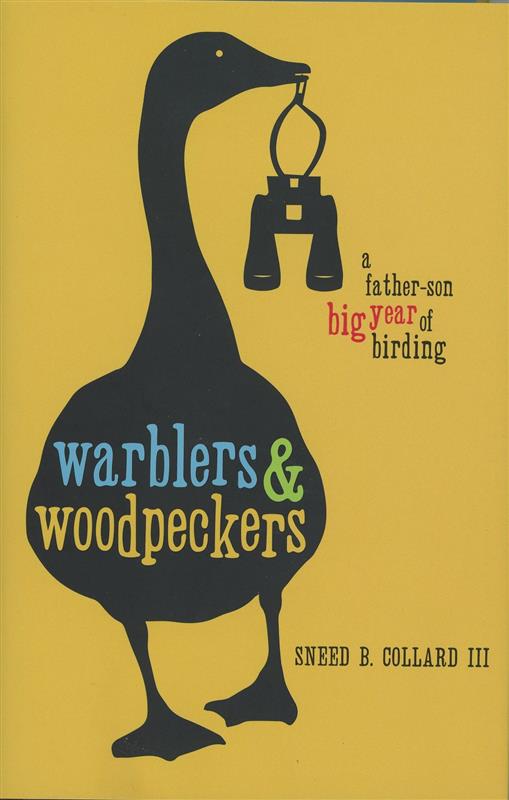
Warblers & Woodpeckers: A Father-Son Big Year of Birding
By Sneed B. Collard III
With intrepid intentions, a phalanx of binoculars and cameras and sly humor, Missoula author Sneed Collard recounts the Big Year of Birding he undertook with his then 12-year-old son Braden. Together, they aspire to count 350 species.
From periodic bouts of “birder battle fatigue” to the enchantment of the Galápagos Islands, the duo scours the western hemisphere for rare and common bird species, aiming to tally 350 birds in 12 months.
They’re a good pair. While his son absorbs identification details “at rates rivaling a Pentagon supercomputer,” Collard – a biologist and nature writer by trade – struggles to distinguish species in the field. Hence the omnipresent camera, which allows him to capture the birds first on film, then confidently identify them later in his birding book.
Highpoints include seeing six California condors soaring “over the ridge like a squadron of B-52s,” a Red-cockaded Woodpecker, Prothonotary Warbler and a Roseate Spoonbill on a particularly fruitful outing in Texas, and on the very last day of 2016, a Northern Pygmy-Owl, tucked into a tree near Maclay Flat on the outskirts of Missoula and dubbed by the duo Bird of the Year.
As the Seattle Times writes, “Accompanying Sneed and Braden Collard is a pleasure whether or not you’re a birder.” It’s a fun and fertile book for anyone who’s enthusiastic about birds, nature, or parenting.
– Kristi Niemeyer
Path of the Puma: The Remarkable Resilience of the Mountain Lion
By Jim Williams
An award-winning Montana wildlife biologist explores the remarkable resilience of the mountain lion – also known as a puma or cougar – in a book lauded by Kirkus as “well-balanced, instructive, and authoritative.”
Jim Williams has been working for Montana Fish, Wildlife and Parks for more than 27 years, and specializes in lion ecology issues in Montana, as well as in the Patagonia region of Argentina and Chile. Throughout his career, he’s helped local communities in both regions conserve mountain lions and other large carnivores.
During a time when most wild animals are experiencing decline in the face of development and climate change, the intrepid mountain lion has been quietly reclaiming historic habitats in the United States, Canada and South America. Path of the Puma explores how wildlife thrives where conservation, community and culture overlap, and offers lessons for the protection of all species in times of dire challenge and decline.
The 312-page hardcover book brims with full-color photographs of the majestic cats and features a forward by acclaimed wildlife biologist and nature writer Douglas Chadwick.
“Written in accurate yet easy-to-understand scientific language, Williams’s heartfelt and comprehensive offering will appeal not only to wildlife biologists, but to nature lovers everywhere.” (Publishers Weekly)
Daughter of the Border
By Roberta Hamburgh
Having grown up in Mirando City, TX, a small oilfield community near the Mexican border town of Laredo, the author weaves the stories of her grandmother, mother and herself into a tale exposing that world of bias and how that changed in her lifetime.
These women, along with the kind and generous men who attached themselves to them, lived in what the poet Randall Jarrell referred to as the “cake of custom, the lung fish embedded in a world of prejudice which one can’t see.” It spewed forth people whose speech belied racial prejudice even as they worked to make living and educational situations better for the groups they placed themselves above.
Hamburgh earned her master’s degree in education and spent four years teaching at the University of Michigan Children’s Psychiatric Hospital. Later she moved to Montana, where she taught and spent the past 11 years as a principal.
“Exquisite! This book … is a tender and living exploration of what it means to be a woman, a girl, a daughter and a human in our complicated world,” writes Molly Caro May, author of The Map of Enough.
Rangers, Trappers, and Trailblazers: Early Adventures in Montana’s Bob Marshall Wilderness and Glacier National Park
By John Fraley
The North, Middle and South Forks of the Flathead River drain some of the wildest country in Montana, including Glacier National Park and the Bob Marshall Wilderness Complex. Retired state wildlife biologist John Fraley recounts the true adventures of people who earned their living among the mountains and along the cold, clear rivers in the 19th and early 20th centuries.
He tells the stories of intrepid Glacier Park Ranger Clyde Fauley and his young family using a cable bucket to reach their isolated cabin across the Middle Fork, trapper Slim Link’s fateful meeting with a grizzly bear in the North Fork, and the life and times of Henry Thol, “the ranger’s ranger,” who happily snow-shoed hundreds of miles at minus-40 degrees to patrol the South Fork wilderness.
Tragedies and near misses abound: a fatal shootout, tangles with bears and packrats, a devastating train wreck, and a missing airplane. But these are balanced with tales of courage, endurance, and remarkable personal achievement. The author tells all in intriguing detail wrested from dozens of interviews, site visits, and extensive research conducted over nearly a decade.
Fraley has written two previous books, A Woman’s Way West and Wild River Pioneers; his latest is published by Farcountry Press.
Sweepers, Snags, and Steam: The Steamboat Era on Montana’s Missouri River
By Ed Wolff
Stevensville author and retired veterinarian Ed Wolff captures the history of Montana’s steamboat era in this engaging new book, accompanied by more than 60 historic photographs of the steamboats that plied the Missouri and Yellowstone rivers and their ports of call.
From 1850 to 1889, hundreds of steamers fought their way up the treacherous Missouri to Fort Benton, the world’s most inland port. By carrying thousands of tons of freight and thousands of passengers, these boats forever changed the character and cultures of Montana and the Northern Plains.
Every trip was full of risks: hull-piercing snags and sweepers, grounding sandbars, powerful rapids, herds of swimming buffalo, Indian attacks, and exploding boilers. The dangers were great but the rewards were enormous – until the railroads came.
Wolff describes in rich detail steamboat construction, river navigation, famous captains, daily life aboard a steamboat, and notable steamboat journeys, including the famous, record-setting trip with wounded soldiers from the Battle of the Little Bighorn that brought news of the “Custer Massacre” to the world.
Published by Riverbend Publishing of Helena, it sells for $20.
Montana Epiphany
By Loring Walawander
In the heart of Pennsylvania’s steel and coal country, most young men in the 1960s followed the generations before them into the mills and mines, but Loring Walawander was different. He dreamed of the open spaces and soaring mountains of Montana – a dream that grew as he dealt with the tics and twitches of undiagnosed Tourette syndrome.
It spurred his tentative first steps out of the nest to college in Tennessee, and was an anchor as he came of age in a turbulent era, witnessing firsthand the conflict surrounding the Vietnam War and racism in the South. And it sustained him through the loss of his first love and his own struggle to survive a near-fatal heart ailment.
Even after he landed a job with the Forest Service in Montana, Walawander had to learn how to negotiate harsh winters, sporadic work, and a tumultuous relationship. Over time, he found a way to live his Montana dream.
“For anyone who’s ever dreamed the impossible, Montana Epiphany tells you that you can achieve it, and that it’s worth the effort,” writes author Gwen Florio of Walawander’s memoir.
The Battle of the Bulge: A Montana Perspective
By Randall LeCocq and John Driscoll
The Battle of the Bulge was the largest land battle in U.S. history, a battle that cost the United States 20,000 lives and stopped the last German offensive of World War II. The authors, both veterans and residents of Helena, studied the history of this battle and walked the critical sectors of the battlefield, examining examples of American heroism and looking for evidence of involvement by Montanans.
Their objective was to better understand this significant battle and how American soldiers managed to stop an enemy steamroller, overcoming their fears while outnumbered more than three-to-one. This book examines the 11 critical junctures of the battle and includes personal stories of Montana veterans.
Under The Biggest Sky of All
By Ron Mills
Longtime Bob Marshall Wilderness outfitter Ron Mills of Augusta recalls a rugged life spent in Montana’s wild country over the past 75 years, working on cattle ranches, shoeing horses and packing people into the wilderness.
The book’s 18 chapters and many photographs chronicle the author’s life from his years spent growing up on the Rocky Mountain Front to stories about the people he worked with, and packed into, the Scapegoat and Bob Marshall Wildeness areas. Mills survived broken bones, as well as broken marriages while often working seven days a week for months at a time. Yet, says the author, “Few people have witnessed the things I have nor enjoyed life more.”
Hal Herring, an Augusta resident and contributing editor at Field & Stream magazine, wrote in the book’s foreword, “I thought I knew that country well. But it is Ron’s stories that make that landscape, and that wilderness, come truly alive in my imagination, peopling it with the wildest of characters, all of them real, human beings, fallible as all-get-out …”
Tags: About Music Books and Visual Arts